A couple of people have been keeping tabs on Lesā and his public appearances for a while now.
One, who says he previously “considered Fale a very close friend” describes Lesā as “charismatic, very intellectually driven”.
But he says he always found Lesā’s stories “odd”, and was troubled that he would introduce himself as a Diplomat, so questioned him. Lesā, he says, stood by the description.
Another who has been monitoring Lesā is Jordan King, a New Zealander currently living in Perth, Western Australia, he’s a researcher by trade. He first came across Lesā in student politics and “didn’t think too much about him”.
But a 2021 story in the New Zealand Herald got his attention.
Headlined, “MIQ ‘fairness’ unfair: Diplomat,” in the body of the story Lesā is described as “Auckland diplomat and consultant”.
For King, “That threw up some red flags”.
So he began collecting information, which is how he saw the Facebook post announcing the Visiting Justice appointment.
“It’s got to the threshold where I think the credibility of Mr Lesā needs to be looked at again in light of that appointment, because I believe there are some assertions that he has made about his record that are not correct.”
Which is why he got in touch with Stuff.
Lesā was keen to elaborate on his previous experiences.
“I think, for me, it’s my career at the UN,” he said. “I’ve been an ambassador, if you like, at the UNDP, a governance specialist. So my role at the UN is to promote good governance. “And a lot of developing countries … good governance isn’t well practiced. And so I get to go into these countries. I’ve been to over 150 countries with the UN.”
He’s been described as both a United Nations Diplomat, and “a seasoned diplomat for New Zealand”.
“Well, I’ve been doing this for 16 odd years.”
I suggested that using the term “Diplomat” implied he’s employed as such.
“There’s no legal description for … if you’re working with the United Nations, you have every right to consider yourself a Diplomat. You’re being paid by the UN. You’re travelling on the UN’s expense. You’re travelling on behalf of the UN, and so I’m very confident that that description is accurate.”
He sent a 2016 report from the 7th Global Forum of the United Nations Alliance of Civilisations, where he is listed as a participant, described as “Alumni Coordinator for the Pacific Region” for ACWAY, which stands for “A Common Word Among the Youth”, and is a global youth movement “promoting peace and understanding through local action”.
He wrote that he had ordered further evidence of his role at the UN, but it could take a couple of days, and in the meantime sent links showing his participation in a series of UNESCO youth forums.
I asked about his Juris Doctor degree from Yale.
“Where did I say that?”
The university in Texas, I told him.
“[That degree] doesn’t exist. What I meant by that is that I have studied at Yale. I did. It was during Covid. It was an online course on governance, yeah, but I haven’t got a JD at Yale. No, where did I say that?”
He accepted it was “a mistake” to have said he had the degree.
After the interview, to support what he’d said about studying with Yale online, he se.nt a link to a Yale website page of “Open Yale Courses”, which provides a selection of “free and open access” recorded lectures.
In terms of study at the University of Auckland, he acknowledged he did not graduate but said he “studied geography as part of the tertiary foundation certificate at the University of Auckland in 2008. Happy to provide evidence of this if needed”.
I asked about being a director for ACC.
“Yes, I’m a current director of ACC. On the Motorcycle Levy Council.”
So, not a director of ACC?
“No, but I’m appointed by the Minister of ACC to oversee the ACC levy for motorcyclists …. What does a director mean exactly? I’m responsible for ACC’s money, yes, so I consider myself a director.”
After the interview, he sent a letter confirming his appointment as a member of the Motorcycle Safety Advisory Council, an independent body which provides advice to the ACC Minister on motorcycle safety.
What about being a senior advisor to Philanthropy New Zealand? It’s been written this role contributed to his “rich experience managing financial assets”.
“Yes,” he said, “I was a member of the youth advisory group that reported directly to the CEO on the advice of the board.”
So not a senior advisor?
“Well, what does that even mean, if you’re reporting directly to the chief executive officer, are you not a senior advisor?
No, says the chief executive of Philanthropy New Zealand (PNZ), Rahul Watson Govindan.
“He was part of a youth advisory group. There was no direct financial management or control, nor decision making powers at all – it was a group set up to support each other as young people in philanthropy and provide PNZ with insights and advice into what young folks were thinking with respect to philanthropy and communities.”
A policy consultant at the Asian Development Bank (ADB)?
“Yes, that’s true. Yes, that can be verified as well.”
Lesā sent a 2020 email from an ADB youth regional programme manager seeking his input into a policy dialogue session for the ADB’s Asia Pacific Youth Symposium, which he’d also attended the previous year.
There doesn’t appear to have been any involvement with the ADB since.
“Unfortunately, due to Covid there was no travel for several years,” Lesā wrote. “You’ll notice the dates align with Covid. This meant that I could not apply for more consultancy work. By the time borders reopened, I was already fully employed in New Zealand.”
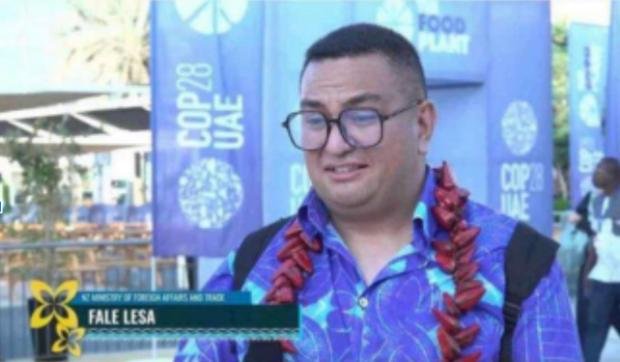
And then I asked about a screenshot from a video that is no longer online, of Lesā apparently being interviewed at COP28 in Dubai in 2023.
The caption named him under the description, “NZ Ministry of Foreign Affairs and Trade”.
Lesā said the video was taken down because there was confusion about who he was representing.

“So my accreditation came from MFAT, but I was representing the UN and so that’s where the confusion lay. The badge came from MFAT and I’ve got emails to prove that.”
He sent a screenshot of an email thanking him for completing the application form to register for a “New Zealand Party overflow badge”.
A spokesperson for MFAT said in a statement to Stuff that “there are no records of Fale Andrew Lesā having been employed by the Ministry of Foreign Affairs and Trade (MFAT).
“Party overflow badge-holders are approved to attend United Nations Framework Convention on Climate Change (UNFCCC) COPs, however these attendees are not part of the official New Zealand delegation. Party overflow badge-holders are not authorised to participate in COP negotiations on behalf of New Zealand or to speak on behalf of the New Zealand Government.”
The spokesperson said Lesā’s application for the badge at COP28 “was initially accepted. However, his badge was later revoked”.
MFAT would not say why. “We consider this a request for personal information, and will progress in accordance with the Official Information Act.”
How officials are responding
Associate Minister of Justice Nicole McKee said in a statement that she was aware of the issues raised regarding “the suitability of a recent Visiting Justice appointment”.
She said she had asked the Ministry of Justice to review the matter.
“It’s important to gather the facts before commenting on the details of the case.”
Chief Legal Counsel at the Ministry of Justice, Edrick Child, said the Ministry was considering the concerns and would be providing advice to the Minister.
The Ministry could not give a timeframe for how long it would take to provide that advice.
Tony Pugh, National Manager and Registrar of the Royal Federation of NZ Justices’ Associations, responsible for JPs, said it was not appropriate for the Federation to comment “on disciplinary matters in relation to Justices of the Peace”.
“However, we are aware that matters have been referred to the Minister. It wouldn’t be appropriate to comment on the nature of any issues or complaints.”
‘People will come for you’
To Lesā, it’s straightforward.
“You should be aspirational when you’re selling yourself for jobs, ambitious. And that’s exactly what I’ve done,” he said. “I think it’s about selling yourself when you need to. And I’m very frank that when you’re in a job interview, when you’re in the media, you don’t exaggerate, but you sell yourself. And that’s what I’ve done, and I stand by that. I haven’t done anything wrong.”
He believed concerns being raised about him were “in the nature of being in the public eye”.
“People will come for you. People have their criticisms, and those are valid. But if you look at what I’ve achieved, if you look at what I’ve delivered, I stand by my record.”
In his emails sending evidence to support the way he’s described himself, Lesā was unfailingly cooperative and polite.
“I want to thank you for giving me the opportunity to defend myself,” he wrote. “I’m grateful to live in a country where due diligence still means something.”