A new study published in the scholarly journal Infrastructures says the guardrails commonly found on public roads might be good for cars, but they have basic drawbacks that make motorcyclists unsafe. Working from this unpleasant basis, the study says there are some suggestions that could help, but even the current patents don’t go far enough—but luckily for us riders, the people behind the study have some suggestions of their own.
Any motorcyclist who’s cast a critical eye on guardrails has probably had a few doubts of their own, study or no study; a friend of mine who put down many miles on German roads told me they call the steel-cable guardrails “cheese slicers” (or something close to that, in German) because a rider hitting one of those wires at speed was going to be in bad shape, very quickly. But the now-common W-barriers that we see everywhere come with their own challenges, says the study published in Infrastructures. For cars that hit them head-on, the elasticity in the W-barriers’ design means the four-wheeled vehicles bounce off and are much safer than something like a concrete Jersey barrier.
But a motorcyclist doesn’t necessarily hit the W-barrier square on its vertical surface; the rider can come off the bike and be bent over the top of the W-barrier, concentrating a lot of force and potentially focusing damage into a small part of their body. As the study puts it:
In such a case, due to inertia, the upper part of the motorcyclist’s body bends over the upper sharp edge of the SSB guardrail. Which part of the motorcyclist’s body bends over the upper edge of the SSB guardrail depends on the height of both the motorcycle and the motorcyclist. As a rule, the motorcyclist’s body bends over the lower ribs or internal organs, where injuries are most dangerous. In addition, motorcyclists’ heads are protected by a helmet; their hands by gloves; and their shoulders, elbows, and knees by protectors, but the ribs and internal organs have no protection.
There are patented solutions to this problem, including top plates or simple covers for W-barriers even cage-fencing for the top of Jersey barriers. If you check out the study here, you can see a list of the different options available, and the study’s authors’ critiques of the existing designs.

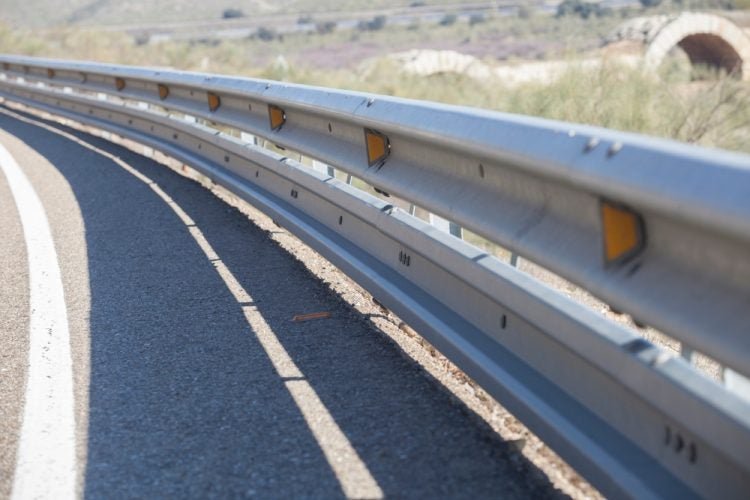
There have been some improvements to guardrails in Europe, with barriers underneath the main rail section that prevent a rider from sliding under and impacting the post or going off a cliff. But there is still room for improvement, say this study’s authors. Photo: WH_Pics/Shutterstock.com
The study wraps up by saying the adoption of the Motorcyclist Safety Barrier (with a plate below the main rail that prevents the rider from sliding underneath and crashing into the guardrail’s posts or going over a cliff edge) was a positive step forward. However, the study calls for more research into improvements to the top of guardrails, aimed at motorcycle safety. The researchers say organizations that represent motorcyclists (such as FEMA in Europe, where this study was published) need to be part of this research to make sure the results are based on real-world evidence.
It makes sense, and it is good to see FEMA involved in efforts that improve its members’ safety without intruding on their rights.