
Hackathons serve as collaborative spaces where creative minds unite to tackle pressing challenges. At UNITAR, we use hackathons as an integral part of our Road Safety Global Training Initiative , fostering multidisciplinary collaboration and empowering participants to co-create digital tools, policy approaches, and awareness campaigns that support the Decade of Action for Road Safety 2021-2030 . By bringing together students, developers, policymakers, and road safety professionals, our hackathons promote practical, data-driven solutions that can save lives on the road
MotoAI Virtual Hackathon (14-15 November 2025)
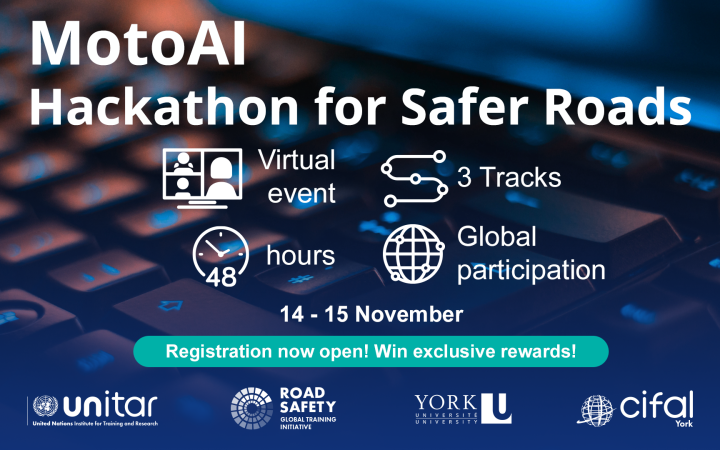
In this spirit of innovation, UNITAR, in collaboration with York University and CIFAL York, convened the MotoAI Virtual Hackathon on 14-15 November 2025. This two-day event brought together participants from eight countries and across disciplines to enhance ” MotoAI ” – our AI-powered motorcycle safety platform – by developing new app features, public engagement strategies, and analytical models to strengthen road safety systems.
With motorcyclists accounting for nearly 360,000 preventable deaths annually, the hackathon addressed one of the world’s most urgent public health challenges.
The MotoAI Virtual Hackathon ran for over 48 hours in a fully virtual format, designed to foster collaboration among participants from countries with high motorcycle fatality rates.
Participants were assigned to one of three thematic tracks:
- Track 1: App Features, Predictive/Analytic Models, & UX Enhancements – Propose new MotoAI app features to improve user experience or reporting functionality.
- Track 2: Community Engagement Campaigns – Design a scalable communication strategy or campaign plan to promote the app in a specific region, country, or demographic.
- Track 3: MotoAI in Action – Explore how specific groups, such as motorcyclists, policymakers, or road safety advocates, can use MotoAI to change behaviours, influence decisions, or improve safety.
A panel of ten international judges, representing academia, the private sector, and social marketing from Canada, the United Kingdom, the United States, and Brazil, evaluated submissions based on innovation, feasibility, impact on road safety, and presentation quality.