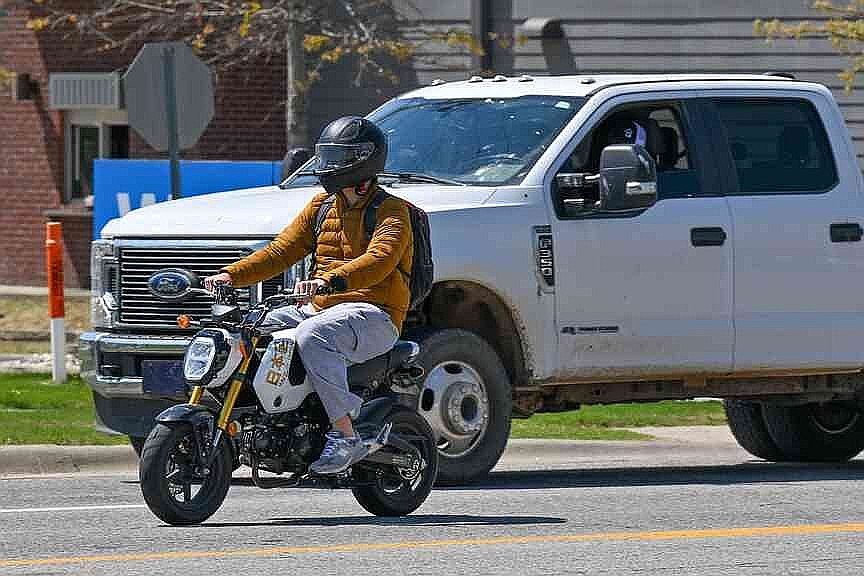
A motorcyclist rides Wednesday on Wedington Drive in Fayetteville. The month of May has been declared Motorcycle Safety Month and was established to help protect motorcycle drivers on the road. It aims not only to remind motorcyclists of the dangers of riding, but also to increase their awareness and the awareness of other motorists. Visit nwaonline.com/photo for today’s photo gallery.
(NWA Democrat-Gazette/Caleb Grieger)A motorcyclist rides Wednesday on Wedington Drive in Fayetteville. The month of May has been declared Motorcycle Safety Month and was established to help protect motorcycle drivers on the road. It aims not only to remind motorcyclists of the dangers of riding, but also to increase their awareness and the awareness of other motorists. Visit nwaonline.com/photo for today’s photo gallery. (NWA Democrat-Gazette/Caleb Grieger)
NEW On the move? Let us read it for you. LISTEN NOW
FAYETTEVILLE — Warmer weather means more motorcycles on the road, and at least 10 motorcyclists have been killed in crashes on the state’s highways since late February, according to the Arkansas State Police.
Capt. Brad Lann with the Arkansas State Police Highway Patrol Division said there’s typically a spike in motorcycle crashes in the spring, and May is Motorcycle Safety Month.
“This time of year, the weather’s getting nicer, and people had them put up in the garage for several months, and then they get out, start riding them more, and it seems to take the public a little bit longer to get used to seeing them out and about,” Lann said.
“They’re not used to seeing them in those winter months, and so they’ve got to pay a little closer attention, especially when pulling up to an intersection, because, if you just take a glance, you might not see them.”
Motorists should also look twice before changing lanes and avoid distractions, Lann said. And, as people start mowing grass, they shouldn’t blow grass clippings onto the road because it can create a slick spot for a motorcycle and cause a crash.
For motorcyclists, wearing a helmet can be a life or death decision, Lann said.
“The way the law’s written is, if you’re over the age of 21, you don’t have to wear a helmet,” he said. “But your chances of survival in a crash are much greater. If you have that helmet on and have it strapped properly, your chances should go way up.”
Fatalities from motorcycle crashes in Arkansas have remained pretty steady at just under 100 per year since 2020, Lann said.
Data from the National Highway Traffic Safety Administration’s Fatality Analysis Reporting System for 2016 through 2022 shows there were 4,089 roadway fatalities in Arkansas. Motorists accounted for 75% of roadway fatalities, followed by motorcyclists at 13%, pedestrians 11% and bicyclists 1%. More than half of motorcycle riders who died — 57% — were not wearing a helmet.
Motorcycle riders are 27 times more likely to be killed in a crash than passenger car occupants, according to the administration.
The Arkansas Highway Safety Office has developed a statewide motorcycle safety program to increase public awareness, support rider education and reduce the number of motorcycle fatalities and injuries through enforcement and public information and education efforts.
GETTING ROAD READY
Cpl. Adam Oelschlaeger, a motorcycle officer with the Fayetteville Police Department, said he hasn’t been working a lot of motorcycle accidents inside the city so far this year, but with the warming temperatures, he expects more people will be getting their bikes out of winter storage.
“There’s always that element, when the weather gets warmer and the sunshine starts coming out, people tend to ride their motorcycles a little more frequent than they do in the cold weather,” Oelschlaeger said. “So, when they get out, they’re excited to ride, so maybe they’re going a little faster than they should be.”
Oelschlaeger said he rides a motorcycle at work Mondays through Thursdays. He offered some advice for both motorcyclists and car drivers.
“For just a regular driver, I’d say, you know, look twice for motorcycles when you’re making a lane change, or say you’re making a left turn on a busy road, making sure that you actually look twice and see if there’s a motorcycle or a scooter on the road,” Oelschlaeger said.
“As a motorcycle rider, I would say give yourself more stopping distance or reactionary gap than you think you’ll need,” Oelschlaeger said. “So, if you give yourself that buffer zone, you can perceive your hazard, you can react to that hazard, you can get safely stopped or moved out of the way.”
Oelschlaeger said motorcycle riding is a perishable skill, meaning riders should be aware their skills can degrade if they’re not riding over the winter months.
“Just like anything else, you don’t do it for a while, and you get back on and you start doing things that you were comfortable with last summer and toward the end of the fall, the motorcycle may behave a little different,” he said.
“It hasn’t been going down the road, so maybe the brakes are in a little different condition. Maybe the fluids degraded, so your stopping distance is going to be increased. Your tires may be worn or dry rotted, or most of the time, they’re just low on air pressure.”
Oelschlaeger said too often when somebody wants to ride a motorcycle, they just start it up and go.
“So you need to pretty much go over your bike in the spring before you are doing serious riding,” Oelschlaeger said. “I would recommend definitely inspect it visually, and maybe if you’re in a neighborhood, run it around the block or find a parking lot somewhere and do kind of a feeling out process and make sure you have plenty of air in your tires, your fluids are good, your tires are in good condition. Check the braking, make sure there’s nothing goofy on that.”
Motorcyclists should also make sure no critters have made homes inside the nooks and crannies of their bikes, he said.
“Some of these bigger bikes have the big saddle bags and all these different parts, and who knows? You might have had a bird nest in there, a squirrel or, you know, critters seeking some warmth and some cover,” Oelschlaeger said. “They can go to creative places.”
SEEKING PROFESSIONAL HELP
Motorcycle riding classes are available at several locations around the state including Pig Trail Harley Davidson in Rogers. They can be helpful for those new to riding motorcycles and needing basic instruction and the ability to pass a riding test. Those who have been away from riding for a while or who just want to improve their riding skills could also take classes.
Keith Poor, riding academy manager at Pig Trail, said the classes stress safety above all else. Poor has worked at the academy for 11 years, taught more than 200 classes and more than 1,700 students.
“We’re trying to make a difference every day that we’re out there, and all of our coaches are really built on a solid foundation about teaching safe habits because we don’t like hearing about the motorcycle deaths either,” Poor said.
Instruction is also available at the Motorcycle Safety and Training Center in Fort Smith and Rock City Harley Davidson in Little Rock.
“I believe that riding a motorcycle is just like any other sport. You’ve got to practice at it in order to become better,” Poor said.
The training courses are built on the curriculum of the Motorcycle Safety Foundation, a national organization that has been teaching people to ride motorcycles for more than 50 years, Poor said.
“Our classes, the bulk of them, are for brand new riders, new riders that have never ridden a motorcycle before. And that’s with the bulk of the people that come in,” Poor said. “The second tranche of riders are the people that have been away from it for say 10 years, 15 years, and they want to get back in it. So they want to take a refresher. And then there’s also that rider that just wants to improve.”
Successful completion earns the rider a license waiver that gets them a motorcycle endorsement on their license.