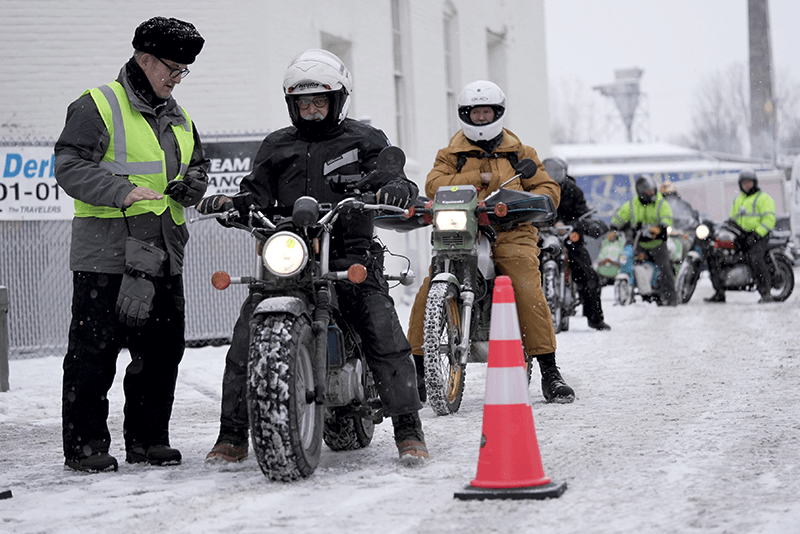

Nine racers lined up to begin the I-Cycle on January 1. Two racers dropped out at the beginning, leaving only seven racers to compete. (Davis Steen)
A sputtering of engines and the smell of gasoline filled the cold air around the south end of the Thorp Building, 1620 Central Ave. NE, on January 1. Nine motorcycle and moped riders were queued on their vehicles, ready to start their race. The 76th annual Twin Cities I-Cycle Derby was on.
The I-Cycle Derby pits any drivers willing to brave the cold against one another to see who can navigate the two over-20-mile courses in the correct amount of time. (The Derby is open to any motorized vehicle that is open to the outside air.) Jim Weatherhead, part of Team Strange, a motorcycle riding club, organized the event.
“I took (the derby) over two years ago; this is my third year running it,” Weatherhead said. “I used to compete in it back in 2005.”
The engines continued to idle. The vehicles — ranging from large, snow-tired motorcycles to a moped with a sidecar — were ready. The variety was a far cry from the two types that competed in the first event.
Battle of two manufacturers
The I-Cycle Derby started in 1949 as a friendly competition between two motorcycle dealers, Indian Motorcycle and Harley-Davidson. The two companies, incidentally, are the only American motorcycle manufacturers to have survived the Great Depression.
“Bob Hoffmeister was a Harley dealer, and Roy Edberg was the local Indian dealer,” Weatherhead said. “The first winner was Edberg and his Indian Motorcycle guy.”
The event used to have riders drive far and wide, logging many miles along the way. “They went from Rochester to Bloomington in ’49,” Weatherhead said. “That was the Gopher Motorcycle Club (that led the event).”Nowadays, the riders stick to Minneapolis and St. Paul. With 75 years of tradition leading them to this year, the riders set off one by one from their starting point just behind Diamonds Coffee Shoppe. The engines grew quieter every thirty seconds as the riders started down the alley behind the building, leaving only the odor of fuel behind.

Axel handed out a time card to racer #7, indicating they had made it to the first checkpoint. Axel was one of the five or six volunteers at the checkpoint recording times and points of each racer. (Davis Steen)
Be there, just not too early
I-Cycle Derby is a race between motorized vehicles that are open to the outside air. This generally refers to motorcycles, but mopeds and various other vehicles have competed historically, as well.
“Everything from 50cc Hondas (dirtbikes) to full-dress Harleys (motorcycles),” Weatherhead said. “The rule is: your vehicle has to have a handlebar and you have to straddle it.”
The race goes through the streets of Minneapolis and St. Paul and is split into two halves: One in the morning, one in the afternoon. The riders have two checkpoints on each route. They know about one of them; the other is a secret. These determine time and points.
The goal of each rider is not to finish it quickly, like one would think in a race-style competition, but rather to be as close to the time plotted out by Team Strange as possible.
“If (a rider is) early, even by a second, they get two points,” Weatherhead explained.
If (the rider) is late, even by a second, it’s one point. Of course, it’s a low score winner.”
At the first checkpoint near Lake Bde Maka Ska, volunteers were waiting for the riders to come by. The slick road conditions had slowed things down a bit more than usual.
Checkpoint 1
Two of the riders dropped out right away. One’s bike wouldn’t start, the other “decided to stop and go back home. He told me his hands were cold,” Weatherhead said.
At the checkpoint on the southern tip of Lake Bde Maka Ska, Linda Theissen and five other volunteers waited at the checkpoint for the delayed competitors.
“Axel hands out the second set of cards. This is his second year doing it,” Theisen said. “These girls are looking to see when the rider puts their foot down to write down the time in seconds.”
Fans stood on the opposite side of the parkway, hoping to catch a glimpse of the competitors or support their riders with hugs or hot coffee.
“The riders are about nine minutes late at this point,” Theisen said. The group of volunteers quickly got into their places as it was announced that a competitor was coming.
The rider slid into place at the checkpoint, feet touching the ground while the vehicle was still moving. Times were yelled out, Axel ran up to the rider and gave him a card, and the rider, just as quickly, peeled off down the road, engine noise and gasoline smell disappearing with him, until the next rider came by 30 seconds later.

Sidecars can offer a leg up in the competition if the other person navigates. Only one entrant used the strategy this year. (Davis Steen)
The 2026 event
The I-Cycle Derby has had as many as 50 riders in a year. The average is 20 to 25, but the attendance depends on the weather, as it does with any event in winter in Minnesota.
In an email after the event, Weatherhead said having nine participants “given the brutally slippery conditions, was a good turnout.”
The morning of January 1, 2026, had temperatures at 3 degrees that only climbed to around 12 by midday. Every rider was bundled in head-to-toe winter gear.
The participants and fans were excited about Andy Goldfine being one of the competitors. Goldfine is the founder of Aerostich, a Duluth-based clothing company specializing in motorcycle safety gear, having revolutionized weatherproof riding gear in the ‘80s. “He’s a fascinating person,” one of the event volunteers said.
After the first heat in the morning, the seven remaining competitors, along with their supporters, sat in Diamonds Coffee Shoppe and enjoyed a hot lunch. The smell of gasoline had followed them into the cafe. Weatherhead entered the space with a leaderboard. Riders gathered around to see how they fared.
The winners
The competitors rode for 120 minutes on the cold January day. They averaged between 16.1 and 22.2 miles per hour, if they stayed true to the course.
After all that riding, they still ended in a tie. Weatherhead’s email gave an explanation on how he determined the winner.
“The last “card,” aka the finish line, is the tiebreaker, which is determined by who is closest to a perfect time. This year, 2nd place was 59 seconds late, 1st place was 11 seconds late, so by a difference of 48 seconds after riding over 40 miles and 2 hours, 1st Place went to Tom Schnieder.”
With that, the 2026 I-Cycle Derby was over and the top five finishers received trophies. Only two competitors dropped out, and the competition still held, as it has for all but two of the past 78 years.
76th mostly-annual
This was the 76th Twin Cities I-Cycle Derby, having missed a few years due to the COVID-19 pandemic. Two events were lost in those years, but Team Strange hopes to run the event as long as they can.
“It’s inevitable that, you know, we’re all getting old,” Weatherhead said. “I have a point, you know.” He continued, stating that the biggest reason the event even has a spot is thanks to Diamonds Coffee Shoppe and Lucy, the shop’s owner.
“Lucy stepped up,” Weatherhead said. “And when she decides to finally retire, it’s like, ‘Oh, where are we going to go next?’”
With the heartiness of the competitors and the people who choose to brave the fierce winters of Minnesota, it is likely one of the next riding clubs could step in to ensure the derby, and that gasoline smell, never leave the area.