
By Neal A. Johnson, UD Editor
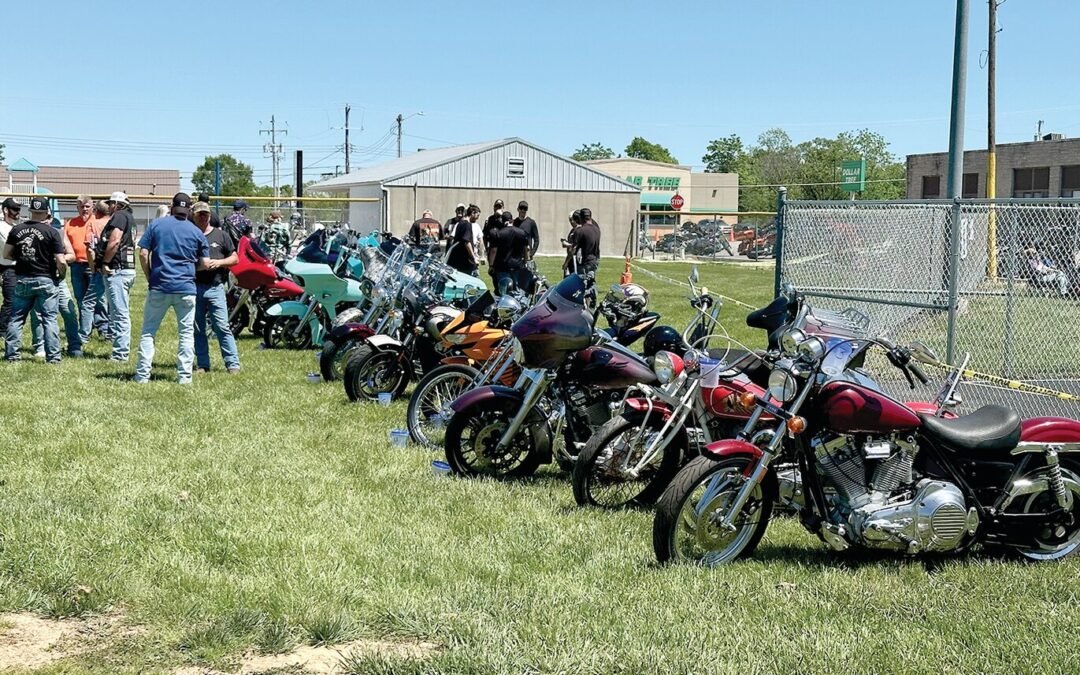
LINN — Linn-area residents didn’t have to look far Saturday to see how a small-town community can rally around a shared purpose, as three motorcycle-based organizations gathered at the city park to promote awareness, support one another, and extend their reach across multiple layers of need. Organizers estimated several hundred motorcycle riders attended the event, along with several vendors.
Each group arrived with its own mission — child advocacy, spiritual outreach, and rider rights — but the overlap was unmistakable, with proceeds, presence, and purpose all feeding into a broader effort to serve others.
Bikers Against Child Abuse (B.A.C.A.) members focused their message on protecting children and supporting families navigating trauma, emphasizing both training and direct involvement.
As noted on the organization’s website, B.A.C.A. began as an effort to help one wounded child in Utah. That child, 8 years old at the time, was so frightened of his perpetrators that he would not leave his home. The founder, recalling positive experiences with bikers in his youth, brought the child into his circle. Within weeks, the boy was seen riding his bike and playing with other children. The idea grew into a broader mission, formalized in 1995 with the first organized ride to support children, which included 27 bikes. Shortly after forming the first non-profit chapter in Utah, another chapter was formed there, followed by others in Oklahoma, Missouri, and Texas.
The mission is not to replace a child’s strength, but to help children and their families recognize their own power.
When a child is scared and feels the need for the presence of their new B.A.C.A. family, the child may call upon these bikers to go to the child’s house and provide the necessary reassurance to feel safe and protected.
B.A.C.A. members and supporters also provide escorts for children if they feel scared in their neighborhoods; ride by their homes regularly; support the children at court and parole hearings; attend their interviews; and stay with the children if they are alone and frightened. B.A.C.A. members never go to the child’s house alone and never without the knowledge or permission of the parents.
Everything is grounded in preparation and awareness of each child’s individual experience.
“You especially want to know that child’s triggers, so when we do meet them, we don’t trigger them,” said Boo Boo, a member of the group.
B.A.C.A. members meet children where they are, both physically and emotionally, working in homes or public settings, depending on comfort level.
“We’ll go meet with the child at their home or out in the community if they want,” Boo Boo said. “The parents are usually really supportive.”
Victims of abuse are supported throughout the process involving their case. Boo Boo explained that some children are referred to B.A.C.A. by the Court Appointed Special Advocates (CASA) of mideast Missouri.
CASA advocates for the best interests of children of abuse and neglect who are under the protection of the Franklin County, Gasconade County, and Osage County Juvenile Courts.
Through highly-trained community volunteer advocates, the child’s needs are heard, researched, and advocated for throughout the duration of the child’s time before the court, thus securing a safe and permanent home for all such children.
B.A.C.A. fully supports that mission, and also helps children after their parents contact the organization.
Training remains a constant piece of B.A.C.A.’s mission, with structured courses and regional collaboration shaping how members approach each situation.
“We have our own training trainers, and we do a lot of it online,” said Boo Boo. “It can last anywhere from an hour to more than an hour, depending on which course you’re taking. All the chapters in North America get together in St. Louis and have training classes.”
That same focus on awareness extended into the public setting, where B.A.C.A. used the event as an opportunity to connect with the community.
“If they have little events or something, a local chapter might go to set up an awareness booth, like we’re doing now,” Boo Boo noted.
Children are provided a denim vest or “cut,” which includes their road name, as well as a teddy bear or other small comforting gift.
“I don’t know a lot of these kids by their real name,” said Boo Boo, whose road name is all that most children learn of his identity. “We don’t go up to kids in public, but they are always welcome to approach us.”
The Jefferson City chapter serves far fewer kids than larger areas like St. Louis, Kansas City, or even Columbia.
“Some chapters may work with five kids all year, and others may see 50 or more,” said Boo Boo. “It just depends on the area.”
B.A.C.A. membership requires access to a reliable motorcycle, attending monthly meetings, rides, court hearings, and other events, and riding with the chapter for a minimum of one year. A criminal background check is also conducted to ensure no members have a history of abuse or domestic violence involving children.
Several events are held throughout the year, with April being the biggest ahead of Motorcycle Safety Awareness Month in May. “All proceeds from the merchandise we sell go right back to the kids, whether it be training for us to be with the kids, or therapy,” Boo Boo said.
A summer barbecue and Christmas party are held for the kids each year, which members said provides them with a fun environment.
B.A.C.A.’s Mid Missouri Chapter in Jefferson City meets on the second Saturday every month at 6:30 p.m. at 2409C Hyde Park Road, and the public is welcome to attend.
Nearby, members of the Christian Motorcycle Association (CMA) Disciples 1023 Chapter, based in Belle, approached the day from a spiritual perspective, describing their work as a ministry built on outreach and service.
CMA President James Redden explained
The organization was founded in 1975 by a pastor named Herb Shreve in Arkansas, whose son needed more guidance. “He bought two small motorcycles, and they started riding together,” said Redden. “They would go to one place and pray for someone, then to another, and so on. The Lord told him there’s a ministry here. He didn’t want to do it, but he did.”
His personal mission grew into an organization with 120,000 to 140,000 members across 50 states and 30 countries.
CMA members said their role centers on providing comfort and connection, both locally and through larger coordinated efforts.
Their mission includes organized rides and prayer-based outreach events. “All CMAers are supposed to ride, and then we pull over at a safe place and pray for the country and all the needs,” said Redden.
Financially, CMA operates on a donation-based model, with proceeds supporting both its own work and other organizations. “That’s the only thing we ever ask for donations for, and that money is contributed to three other organizations,” Redden noted, pointing to tables with materials for those in need of spiritual guidance. “All of this we paid for out of our own pockets, and when it’s free, we don’t charge anything for it.”
The organization remains open to anyone interested in participating, regardless of whether they ride.
“Anybody can join; you do not have to own a motorcycle,” Redden said. “You’ll never be charged dues or anything like that; it’s all free-heart donations.”
CMA has members from the immediate area, including Linn. The group meets on the second Thursday of each month at 7 p.m. at the Belle Assembly of God at 506 East First St.
While CMA focuses on spiritual outreach and B.A.C.A. promotes child advocacy, the Freedom of Road Riders helped anchor the event with a “prettiest bike” competition and bike games, with proceeds donated to B.A.C.A.
Freedom of Road Riders members described their group as an organization rather than a traditional club, emphasizing a broader mission tied to advocacy.
The main purpose of this organization is to guard the rights of all motorcyclists; to keep them informed of laws that will help or hinder them as motorcyclists; to promote safety, rider education, brotherhood, and freedom for all motorcyclists.
“We fight for the rights of motorcyclists to have their freedom,” said President Aaron Gaska, noting that advocacy has included legislative efforts, education, and ongoing engagement with the riding community.
At the same time, the group remains flexible in how it supports others. “We don’t care who we support, as long as they’re doing something right,” another member said.
Events like Saturday’s gathering are part of a larger calendar that keeps members active throughout the year.
“We normally do a fun run once a month, poker runs, cornhole tournaments, bike shows, bike games … we just keep on going,” Gaska said.
The organization also hosts larger annual events, including a Valentine’s Day dance called “Leathers & Lace” that serves as a major fundraiser.
“That is our main big event, and we always look forward to it,” said Gaska, noting the dance always includes live bands in a fun atmosphere.
Next year’s event will be held on Feb. 13, but the location has not yet been determined.
Despite differences in mission, members across all three groups acknowledged the mutual respect and shared purpose that brought them together.
“We fight for a lot of things in our own ways,” said Gaska. “I think everyone respects each other.”
Follow Freedom of Road Riders on Facebook.